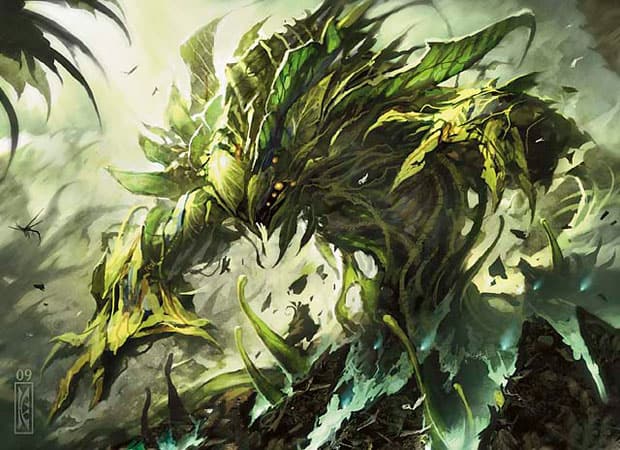
Hello, dear reader. My name is Matthew Szawlowski and I…have an unfortunate last name. More to the point, I also happened to qualify for the Canadian National Championships a few weeks ago. I have played Magic: The Gathering casually and intermittently since the release of Invasion. I returned to the game around the release of Zendikar, and with the help from some valued friends, acquaintances, and respected peers, have been trying to make waves in the ocean that is competitive M:TG. I’ve participated in many of the local major events, each time leaving with a respectable but unremarkable finish. My qualification for Canadian Nationals marks my first and most significant major competitive achievement thus far. But enough about me…
The expected metagame for this tournament was Birds, Jaces and Swords in overwhelming numbers. This was based both on the precedents set by past events, and the fact that practically every recognizable name in the M:TG community was pushing the idea that any person with the ultimate goal of winning a tournament would be making a mistake if they chose not to run CawBlade. Consensus suggested so strongly that CawBlade was the best deck in the format that it had actually manifested its own metagame within the archetype, with pros functioning under the assumption that every knowledgeable pilot should, and most likely will be running some Caw variant, therefore card choices should be made with the goal of gaining an edge in the mirror.
Consequently, stock Caw lists began to shave numbers on larger creatures, hard removal, and mass removal spells in favour of single-target, tempo generating spells such as [card]Condemn[/card], [card]Oust[/card], and [card]Tumble Magnet[/card], which are all quite efficient in their utility, but don’t serve as permanent solutions to a board state composed of multiple must-answer threats. This perceived weakness in the metagame led me to believe that a deck designed to abuse [card]Vengevine[/card] would be quite well-positioned to take a tournament by storm. And this assumption would have held true, were it not for the other elephant(s) in the room: The Ramp Decks.
While I expected at least half of the room to be piloting some combination of Jace, Gideon, [card]Stoneforge Mystic[/card], and [card]Squadron Hawk[/card], and assumed that my match against the various aggro archetypes would be fine as-indicated by my test results, the Ramp decks (RUG, Valakut, Eldrazi) of the format have a well-earned reputation of crushing midrange creature strategies that traditionally lack ways to interact with their late game. This is a problem that immediately invalidates archetypes such as Elves and traditional G/W midrange in my eyes.
The theory behind my original choice is that the G/W ShamanVine core has a proven ability to win long, grinding attrition wars against removal heavy control decks by virtue of the sheer threat density necessary for the engine, and access to one of the most persistent threats ever designed in Vengevine. However, there are three weaknesses inherent in the engine that makes the deck a perennial dog to ramp decks by-design, which are:
1. The central [card]Fauna Shaman[/card] engine takes a lot of time and investment to achieve peak efficiency, which is met at around turn 5 or 6 on average. The ramp decks of the format goldfish to their end-game board state by turn 4 on average, and as early as turn 3.
2. The end result of the time and investment in the ShamanVine engine is a board flooded with x/2s and x/3s, which aren’t particularly threatening to decks that turbo out creatures with stats that ring in at 6/6 minimum, most of which are capable of either dealing direct damage in increments of 3, or literally ending the game outright with one attack phase.
3. The central engine of the deck requires the pilot to run a critical mass of creatures to function at peak efficiency. As such, there is very little room in the deck for interactive non-creature spells. This is a problem because creatures are a notoriously bad way to try and interact with Titans and Eldrazi.
In sum, Ramp decks goldfish faster than you, run creatures that outclass yours in almost every way imaginable, and your deck choice requires you to exclude most spells that interact with problematic permanents that aren’t dealt with by turn dudes sideways. Oh, and before I forget, [card]Pyroclasm[/card] and [card]Slagstorm[/card] kill basically every creature in your deck.
All this considered, my first attempt to solve the matchup was G/W Quest, reason being that if the deck of your choice has no way to interact with the late-game of one of the most popular decks in the format, design your deck to ensure they never make it to their late game. Attacking for 6-8 on turn three and blowing up one of their lands upon every successful attack afterwards seemed like a good way to do this, in theory. The problem, however, is that sometimes, you don’t start with the T1 Quest, and then are forced to either mulligan into oblivion, or subject yourself to the nightmare outlined above. Neither of these are particularly favourable options.
Beyond that, the secondary Quest engine is comprised of nothing but Quests, [card]Memnite[/card]s and [card]Ornithopter[/card]s, and ways to extract maximum value from said [card]Memnite[/card]s and [card]Ornithopter[/card]s. This is a problem because in your attempt to improve your match-win percentage against ramp decks, the spell core necessary to accommodate this package will weaken your percentages against the rest of the field, because you then become a deck full of [card]Memnite[/card]s and [card]Ornithopter[/card]s. The tradeoff of course, comes in the potential to god-draw opponents out of the game. Sounds good, doesn’t it?
Unfortunately, the reality is not consistent with the idea. This is because a not-insignificant percentage of the metagame has chosen to respond to the predominance of CawBlade by overloading on artifact removal spells (which, for the record, is a terrible plan. It is far more effective to invalidate their creatures than it is invest in targeting cards they essentially got for free) and single-target solution cards such as [card]Tumble Magnet[/card] (which, for the record, is a fantastic solution. More on that later). Suddenly, those [card]Memnite[/card]s, [card]Ornithopter[/card]s, and [card]Argentum Armor[/card]s aren’t looking so hot. This, along with the necessary consistency for power tradeoff that comes with picking up this archetype, led me to explore other options.
The next option was to look into the addition of a splash color. Those familiar with the color pie will know these as Blue, Black, Red, or some combination of all of the above. First was Blue, AKA the most powerful color of all time. This one should have something for me. Alas, it did not.
The strongest potential additions offered to the deck by Blue were counterspells, [card]Jace, the Mind Sculptor[/card], and [card]Frost Titan[/card]. The option of countermagic was immediately disqualified, as its ideal usage runs in polar opposition to what the deck is trying to accomplish. Countermagic requires one to keep mana open on every turn. On the other hand, this deck wants to be casting must-answer threats at every point in the curve, starting on turn 2. As such, it cannot afford the loss of development necessary to accomodate counterspells.
While JTMS was a nice addition, being one of the most powerful four-drops ever printed and such, its inclusion did not actively improve the ramp matchup, as Jace does not interact favourably with Titans. The combination of [card]Frost Titan[/card] and [card]Jace, the Mind Sculptor[/card] together was almost enough, as [card]Frost Titan[/card] is the go-to trump card to opposing Titans in Blue. However, it proved too unreliable, as it still interfered with my threat development, and the deck lacked ways to consistently accelerate into a [card]Frost Titan[/card] in time to stifle my opponent’s Titan offensive. That, and I may or may not own Jaces or [card]Frost Titan[/card]s (or the majority of this deck, for that matter. Don’t believe the hype. Card availability IS an issue, folks). The next option was Black.
Black offered some serious potential, as it gave the deck access to true disruption spells. As far as I’m concerned, the biggest incentives to be playing Black are hard removal, [card]Inquisition of Kozilek[/card], and [card]Memoricide[/card]. While the addition of hard removal and Inquisition are strong within the scope of the metagame as a whole, they are not particularly effective answers to Ramp decks. Most of the common Ramp deck’s threat cards enter at the 4 CMC mark and go up from there, leaving outside the range of Inquisition. And as for removal, part of what makes Titans so strong is their ability to generate value immediately upon resolution. As such, trying to solve the problem with a spot removal spell leaves you behind on value, as you have to invest one card to address their one card, and their Titan’s ETB trigger typically has a higher stock-mana value than your removal spell.
This leaves [card]Memoricide[/card] to plead the case for Black. This may be my personal bias speaking, but I hate this card, and this style of surgical-precision answer cards. My biggest problem is that far too often, they don’t actually have an impact on the game at-hand. Of course, against a deck like Valakut, naming [card]Primeval Titan[/card] is a significant blow to the archetype. However, they run a diversified enough threat base that they don’t necessarily have to resolve a [card]Primeval[/card] Titan against you to win the game. [card]Primeval Titan[/card] is an extremely powerful card, but it is only the enabler. The primary threat is a land, and their secondary threat is another game-breaking Titan.
The only time [card]Memoricide[/card] gains immediate value is when you happen to catch then with a Titan in-hand, and even then, it’s four mana for little more than a one-for-one trade. And if you miss? Well congratulations, you spent a key 4 mana on a spell that didn’t actually do anything. Sure, they won’t draw their Titans, but there was no absolute guarantee that they would have regardless. Now what do you do about the [card]Inferno Titan[/card]/[card]Terastodon[/card]/[card]Wurmcoil Engine[/card]/[card]Avenger of Zendikar[/card] etc. that they actually did have in hand? This problem is only exacerbated further when you consider RUG, and how many angles of attack it has. For these reasons, I moved on to Red.
It is at this point that I stumbled across the decklist of a respected colleague running a Naya list with 3 copies of [card]Traitorous Instinct[/card], and the ‘Eureka’ moment occurs. In testing I found it was often not difficult to force through 10 damage or so before falling too far behind. Assuming I can get even one creature to survive through the various removal spells they may play, a [card]Threaten[/card] effect should more often than not connect for lethal, especially when considering that half of Valakut’s threat base in the stock list is now [card]Inferno Titan[/card]. This inclusion seemed like one of the few legitimate answers available to the archetype, and proved itself in testing. Moreover, it came in the colour combination with the strongest manabase and competitive precedence. This, I could work with.
After extensive talks, and constant back-and-forth tweaks, this is the list I registered:
[deck title=Naya Vengenvie by Matthew Szawlowski]
[Lands]
4 Razorverge Thicket
4 Copperline Gorge
3 Arid Mesa
1 Misty Rainforest
3 Forest
3 Plains
2 Mountain
2 Raging Ravine
1 Stirring Wildwood
2 Sunpetal Grove
[/Lands]
[Creatures]
4 Birds of Paradise
3 Squadron Hawk
4 Fauna Shaman
4 Stoneforge Mystic
4 Vengevine
1 Hero of Bladehold
1 Linvala, Keeper of Secrets
1 Hero of Oxid Ridge
1 Acidic Slime
1 Baneslayer Angel
1 Sunblast Angel
1 Sylvan Ranger
1 Viridian Corrupter
1 Kor Skyfisher
[/Creatures]
[Spells]
1 Mortarpod
1 Sword of Body and Mind
1 Bonehoard
3 Lightning Bolt
1 Green Sun’s Zenith
[/Spells]
[Sideboard]
2 Tumble Magnet
3 Kor Firewalker
3 Mark of Mutiny
1 Viridian Corrupter
1 Manic Vandal
1 Sword of Feast and Famine
1 Inferno Titan
1 World Queller
1 Squadron Hawk
1 Thrun, The Last Troll
[/Sideboard]
[/deck]
The Card Choices
4 [card]Stoneforge Mystic[/card]
4 [card]Fauna Shaman[/card]
4 [card]Birds of Paradise[/card]
4 [card]Vengevine[/card]
3 [card]Squadron Hawk[/card]
The central engine, and sacrosanct core of the deck. A suite of the most deceptively powerful utility two-drop creatures in the format, paired with the card that allows us to not fight fair in one of the most busted standard formats in recent memory. The Birds have been a format staple since the dawn of time, and probably require little explanation.
The Tutor Package
1 [card]Hero of Bladehold[/card] -> The mandatory army-in-a-can spell. This slot is dedicated to either [card]Hero of Bladehold[/card] or [card]Precursor Golem[/card]. Based on my conversations the night before, I opted for [card]Hero of Bladehold[/card] primarily because its better against Ramp decks. Granted, it is worse against [card]Jace, The Mind Sculptor[/card], but I felt it important enough to essentially pre-board against Ramp decks, since winning game one ups your chances of stealing a match significantly. Many of my card choices are based on this fact.
1 [card]Linvala, Keeper of Secrets[/card] -> Originally a second [card]Hero of Bladehold[/card], the switch was made both to free up a slot, and because of the functional redundancy between both cards (functional redundancy will also be a common theme explored throughout this section). Both were 4 CMC white creatures that survive a [card]Slagstorm[/card], give Ramp decks fits, and provide superior board presence against a deck trying to kill you with a bunch of 1/1s. *Shout outs to Ben Clinton for showing me the light on this one. It was amazing all day.
1 [card]Hero of Oxid Ridge[/card] -> Generally weaker than [card]Hero of Bladehold[/card], but equally or even more powerful under the right circumstances. This addition gave me 5 MD 4 CMC haste creatures, 3 creatures that hose ramp decks (this by bypassing all their chump blockers), and a random overrun effect, which is naturally strong in such a heavily creature-based deck.
1 [card]Acidic Slime[/card] -> One of the best pure utility creatures in the format. Both artifacts and utility lands are format mainstays and having maindeck answers to those that don’t compromise your core functionality is a huge boon. The only strike against this card is its cumbersome 5 CMC.
1 [card]Viridian Corrupter[/card] -> Based on a suggestion I received as a way to provide some of the utility of a Slime without the 5-mana price tag. There were very few situations in which this was better than a Slime, but those situations were relevant, and with the exclusion of Cunning Sparkmage, the deck was in need of another trump for the Boros matchup, and this fits the bill quite nicely. The infect is often quite relevant.
1 [card]Sylvan Ranger[/card] -> Sometimes you just need a land. This is your safety net for otherwise loose keeps, and provides a cheap means to recur Angry Plants when relatively land-light, by casting it first, fetching a land, activating Shaman, and fetching the most mana-efficient second creature available to you.
1 [card]Baneslayer Angel[/card] -> One of the go-to trump cards against aggro decks that also happens to have a ton of value against the predominant control deck of the format. Its inclusion in the MD wasn’t difficult to justify.
1 [card]Sunblast Angel[/card] -> Included based on the same rationale as [card]Baneslayer Angel[/card], with the caveat that it gave me a meaningful way to interact with swarms and larger creatures that a Baneslayer alone would normally have trouble with. It was generally a non-factor throughout the tournament, but I can envision situations where it would be a total blowout, and there are few better manasinks available to the deck in this format. This slot was originally an [card]Admonition Angel[/card], but I backed out of that choice at the last minute because I hadn’t had to opportunity to actually play with the Mythic, the list was relatively land-light at 25, and it seemed too vulnerable to common card selections (Gideon and Jace, in particular) to risk running blind. *Beware of casting this into an opposing Tumble Magnet. You will be sad.
1 [card]Kor Skyfisher[/card] -> Angry Plant recursion in a can. Running out of creatures is one of the worst feelings one can experience while immersed in an attrition war with a control deck. In that situation, this is the best last-creature-in-hand possible. At the very worst, it comes down on T3 and blocks hawks or picks up a sword and goes to town through the air. If there was one lesson I learned in my time with GW Quest, it is that Skyfisher and Vengevine play very nice together. This one is not to be underestimated.
0 [card]Cunning Sparkmage[/card] -> This card is really bad right now. The whole format is gunning for x/1s and [card]Mortarpod[/card] has been almost universally adopted into any deck running [card]Stoneforge Mystic[/card]. Because of this, the old standby of sitting on a Sparkmage while fetching plants is no longer valid. Additionally, having to burn a [card]Stoneforge Mystic[/card] fetching a [card]Basilisk Collar[/card] is, in my opinion, a terrible waste of resources.
The Utility Non-Creature Spells
1 [card]Mortarpod[/card] -> One of the best utility equipments in the deck. It kills [card]Lotus Cobra[/card]s before they get out of hand, it turns [card]Hero of Bladehold[/card] into a machine gun, and after expending its germ token, straps onto a [card]Fauna Shaman[/card] or [card]Stoneforge Mystic[/card] to put it out of [card]Pyroclasm[/card] range. Additionally, it turns a straggling [card]Acidic Slime[/card] into a high-powered rifle, since deathouch applies to damage dealt upon resolution. Any deck that is running [card]Stoneforge Mystic[/card] that isn’t running this is making a fatal error.
1 [card]Bonehoard[/card] -> The best offensive equipment in the deck. It is the ideal high-end spell to curve into, as once you’ve expended your reserves of midrange creatures, [card]Bonehoard[/card] turns your enablers and all subsequent creatures drawn into lethal threats. It is not uncommon for this to add upwards of +10/+10. Many matchups in the format are largely defined by hawk advantage, which means that even against the premier control deck of the format, this thing is always going to be huge.
1 [card]Sword of Body and Mind[/card] -> Chosen mostly for its synergy with [card]Bonehoard[/card] and its ability to add threat density to a board without having to invest actual cards. Its ability to grant a creature “protection from Jace” and [card]Kor Firewalker[/card]s “protection from RUG” are nice additional value. This will typically be the first equipment tutored for in matchup where [card]Mortarpod[/card] isn’t ideal.
1 [card]Green Sun’s Zenith[/card] -> Because resolving a [card]Fauna Shaman[/card] as early as possible is just that important. Additionally, [card]Fauna Shaman[/card] has huge diminishing returns, whereas the power level of this card scales up as the game progresses. A solid addition.
3 [card]Lightning Bolt[/card] -> All-purpose removal. Its slot is justified mainly because Lotus Cobra is still a major player in the format. It gets sided out quite regularly, but you’ll be happy to have it in most G1 situations.
…And there is the part where I attempt to defend my choice to run only three [card]Squadron Hawk[/card]s:
In his article for G/W Midrange on Channelfireball, Matt Sperling elegantly describes the format as one where CawBlade is the Rock, his list is Paper, and dedicated Ramp decks are Scissors, which, as we’ve established, trump midrange creature strategies by-design. Because of our inherent weaknesses to ramp decks, it becomes that much more important to win game one against them to have a chance in hell of regaining the play in G3 and stealing the match. [card]Squadron Hawk[/card]’s value comes from the fact that it is one of the very few ways this deck has to generate card quantity advantage, but ramp decks are designed to go over the top of traditional card advantage engines. [card]Squadron Hawk[/card] is one of the best pure value cards in the format but its power level in a vacuum leaves much to be desired. Because you don’t have time to durdle around with Hawk and Shaman shenanigans against Ramp decks, Hawks are terrible here.
This begs the question, why didn’t I just bench one of the silver bullets? The answer is that it is very rare that the 4th Hawk will break open a game. Its status is a value card makes it generally good against every non-ramp deck in the format. Similarly, each of the tutor cards are included as marginal value cards that aren’t exactly “bad,” per-se. However, under the right circumstances, each of the siver bullet offer the potential for massive gain upon resolution. The situations are few and far between that resolving the 4th Hawk will be a complete blowout in any single match. The tiebreaker for me is that when conditions permit, each of the tutor targets will completely dominate a game, whereas a Hawk is just another 1\1. That, and drawing redundant Hawks is one of the worst possible draws for the deck at any stage of the game. 3 Hawks is enough to consistently see one per game, and then no more.
Admittedly, the 4th Hawk is very good against CawBlade. However, the addition of [card]Kor Skyfisher[/card] gives me the functional redundancy of the 4th Hawk, and the central engine of the deck is strong enough against CawBlade to not need additional help, so I wanted to walk into the tournament pre-boarded to an extent in G1 against the ramp decks without diluting the deck in a way that would compromise my G1 CawBlade matchup. Moving a Hawk to the board was the most straightforward solution to the problem I could conceive of without running 61 cards or benching one of my tutor targets. That said, there is a case to be made for running 61 cards, and I would not fault anybody for doing so.
The Sideboard
3 [card]Mark of Mutiny[/card] -> The single best reason to be running Red. The biggest attraction to this deck in the first place is that it is one of the only decks in the format that doesn’t run Jace, and has a legitimate plan against CawBlade. [card]Mark of Mutiny[/card] gives is a legitimate plan against Ramp decks, which is severely lacking in any other G/W/x variation. There is an argument to be made for including Traitorous Instinct here, but I thought it more likely that games would be lost to additional 1 CMC than the additional 1 DMG.
3 [card]Kor Firewalker[/card] -> A staple sideboard inclusion against red-based aggro, but this one is also for the ramp decks of the format; Protection bears carry swords quite nicely. Including three makes sideboarding fairly intuitive as well, since against Valakut, this is a strict efficiency upgrade to [card]Squadron Hawk[/card].
2 [card]Tumble Magnet[/card] -> One of the breakout stars of the sideboard. It is one of the best-positioned cards in the format, and only continues to get better as the popularity of Tumble Magnet rises elsewhere. It is yet another card that gives us a legitimate plan against Titan decks and sword decks. Moreover, it gives us a way to force damage through opposing [card]Tumble Magnet[/card]s in clutch situations by tapping their Magnets at EOT. It is common knowledge that in Scars limited, aggro decks are better at taking advantage of the tempo gain of [card]Tumble Magnet[/card]. This constructed format is no exception. It is my personal belief that any deck not running this card or an equivalent is making a huge mistake.
1 [card]Viridian Corrupter[/card] -> See:above
1 [card]Manic Vandal[/card] -> This in theory was another artifact removal option that, unlike [card]Viridian Corrupter[/card], had offensive value when equipped. In practice, I realized there is no mainstream matchup in which you are both the aggressor and you are in need to a sorcery-speed artifact removal spell on T3-4. This slot would have been much better as a second Acidic Slime.
1 [card]Sword of Feast and Famine[/card] -> For those matchups in which you really want two swords. That, and the fact that people still insist on running black-based control decks. This probably should be in the MD if one can find room for it.
1 [card]Inferno Titan[/card] -> Another complete non-factor in every game I played. The theory was that it was the best secondary high-end spell available to the deck, and the single best manasink. In practice, it never came up, and I didn’t care.
1 [card]World Queller[/card] -> This was chosen for its ability to eat Planeswalkers and artifacts, provided that it is beneficial to do so. It performs a niche but still important role, which is why it’s been relegated to the sideboard.
1 [card]Squadron Hawk[/card] -> Sometimes you really do want that 4th Hawk. It came in against every aggro opponent and every control opponent in place of the tutor target that performed the worst. That said, I still stand by my decision to run it out of the board.
1 [card]Thrun, The Last Troll[/card] -> A last minute addition that I’m quite thankful I made. It made its Standard debut with more of a whimper than a roar, as the card was very underwhelming in a format dominated by Titans. This is no longer that format, which makes conditions perfect for Thrun to be an absolute beating. Provided he survives to the untap step with open mana, he is immune to every mainstream form of removal in the format. Needless to say, he carries a sword better than most creatures in the deck.
Suggested Changes
Overall, the deck performed as expected. The top 8 was announced, my name was butchered by the head judge as-expected, but I happily collected my box of product, filled out the information sheet, and walked away qualified for Nationals with a record of 6-1-1. The deck was designed to exploit a perceived weakness in the metagame, in general, it succeeded in that endeavour.
Going forward, the list would receive a minor makeover, as there are some options I would have liked to include. The first of which is [card]Gideon Jura[/card]. Two of the dilemmas having to be addressed in the initial list is first, more answers to [card]Gideon Jura[/card], and second, better top-end spells to take advantage of the mana production this deck is capable. Gideon efficiently addresses both of these needs. To make room for it, I would cut the [card]World Queller[/card] and either the [card]Inferno Titan[/card] or the [card]Sunblast Angel[/card], leaning more towards the Titan.
While [card]World Queller[/card] is a contextual powerful card, its primary justification is as an answer to [card]Gideon Jura[/card]. Running a Gideon of my own is both a more proactive play and generally more powerful than resolving a [card]World Queller[/card]. [card]Gideon Jura[/card] has more value in a wider range of matchups, and addresses more of the weaknesses of the deck than [card]World Queller[/card], who earned his slot more as a humble roleplayer than a dominating board presence. The cut of [card]Inferno Titan[/card] isn’t because [card]Inferno Titan[/card] is a bad card. It’s just that [card]Gideon Jura[/card] is better positioned and I can’t think of a card I would feel comfortable losing otherwise. [card]Inferno Titan[/card] shares Queller’s status as a minor roleplayer in this deck.
Additionally, flipping the numbers on [card]Tumble Magnet[/card] and [card]Mark of Mutiny[/card] maybe correct, though I would caution that a change like that would make the deck more vulnerable to Valakut and RUG. Despite [card]Tumble Magnet[/card]’s stellar performance, 2 is probably correct. The only other change I would suggest is dropping the [card]Manic Vandal[/card] for an [card]Acidic Slime[/card]. The lower CMC simply does not justify the severely limited utility of the red menace. This is emphasized further by the redundancy provided by the inclusion of [card]Viridian Corrupter[/card].
Other than that, I feel very comfortable with the deck configuration, though the nature of the deck makes it almost infinitely customizable. I leave it to the discretion of the pilot to make the choiches s/he feels most comfortable with. Assuming the established metagame trends persist, I wold happily recommend this archetype to anyone not interested in fighting Jace wars for 8-9 rounds. Whether that stays the case with New Phyrexia’s release is another issue entirely…
New Phyrexia Ideas
By the time you’ll be reading this, the spoiling of New Phyrexia will have made most of this all but irrelevant, as I expect the expansion to bring big changes to the metagame. The new toys for Stoneforge Mystic and the addition of a legitimate combo deck entering the fray should mean that the ‘devil we know’ as CawBlade will most likely receive some cosmetic surgery.
Additionally, all the new goodies in other colours add yet another element of the unknown to the metagame with the promise to shake things up. As for Naya, the core of the deck should remain pretty faithful to what’s been established up to this point, but New Phyrexia contains quite a few new toys for people looking to win wars in the red zone. Some of the most intriguing are:
[card]Urabrask the Hidden[/card]-> As far as I am concerned, any creature in our colors that includes the word “Haste” in its card text is worth a second look, and this beast is certainly one of the better ones. The disruptive qualities that an active Urabrask bring to the table are not to be underestimated. This card wreaks some serious havoc on any deck that is hoping to draw out games by using hawks as speed bumps, as tapped birds don’t make very good blockers. But beyond that, [card]Sun Titan[/card]s, [card]Baneslayer[/card]s, [card]Batterskull[/card] germs, [card]Inferno Titan[/card]s, and all the other random fat your opponents are hoping to use to stifle your offense is now a turn slower.
Additionally, an active Urabrask effectively renders any haste creatures your opponents may be packing much less impressive. I should also mention that this card single-handedly invalidates the new [card]Deceiver Exarch[/card] – [card]Splinter Twin[/card] combo, as all of their tokens enter the battlefield tapped. This will be particularly valuable in the early season when the Exarch-Twin decks are still being refined. Lastly, the prospect of tutoring up a [card]Stoneforge Mystic[/card], activating it immediately, and swinging in with your freshly played [card]Batterskull[/card] is just too much value for me to ignore. As the premier five-drop for an offense-oriented deck such as this, this card alone may force me to re-assess the value of Lotus Cobra in the archetype.
[card]Elesh Norn, Grand Cenobite[/card] – > In case being a super [card]Glorious Anthem[/card] on legs and being just large enough to profitably block a Titan isn’t enough, if you read this card carefully enough, you’ll notice that in the middle of the card text, between the -2/-2 and the flavour text, there is a section of fine print marked with an asterisk that reads *Your opponentz can haz no Hawkz or Mysticz anymore”. That seven-mana price tag is unfortunate, but such a powerful effect may be worth the cost of admission.
[card]Sword of War and Peace[/card] -> Basically a strict upgrade to [card]Sword of Body and Mind[/card]. Protection from Hawks, Mystics, [card]Condemn[/card]s and [card]Sun Titan[/card]s AND the ability to attack both a player and a Planeswalker? Sign me up!
[card]Batterskull[/card] -> If ever there was a question as to whether 4 [card]Stoneforge Mystic[/card]s were necessary, there is no longer. This card will be battering many skulls in the very near future.
[card]Jin-Gixatas, Core Auger[/card] -> IT’S A CREATURE THAT DRAW YOU SEVEN CARDS!!! Just kidding. Unless your name is Conley Woods or Ali Aintrazi, don’t play this card.
[card]Beast Within [/card]-> I’m on the fence about this one. An instant speed Vindicate should be an auto-include in theory, but the 3/3 body that comes with it is significantly disruptive to our primary gameplan. Turning Jaces into [card]Trained Armodon[/card]s may be enough of a case for the card, but Planeswalkers alone aren’t particularly threatening against this deck. This card has serious potential, but I am not willing to go as far as to snap-slot it in just yet. We’ll leave this as “requires testing”.
[card]Birthing Pod[/card] -> Yet another wildcard. This has the potential to enable some really broken things to happen, but it does nothing on its own, and requires quite a few slots in a deck with very few to spare. I wouldn’t be surprised if someone ended up making waves with this card in the new format, though I doubt at this point if that guy will be me.
[card]Act of Aggression[/card] -> I saved this one for last because its printing is the strongest case for abandoning the red splash altogether. I mentioned earlier that a threaten effect was the single biggest reason to be playing red alongside green and white and the existence of that card makes my rationale invalid. This card is strictly better than [card]Mark of Mutiny[/card]. At the cost of four life, it alleviates any mana concerns you may have had, and grants instant speed, which is hugely relevant. Stealing Titans at EOT and following up with a haste guy, as well as threatening to mess with combat math at any stage of the game where you leave open three mana is some serious shenanigans. And before I forget, this also invalidates the Exarch-Twin combo, but this one kills them in the process!
New Phyrexia has been assigned the burden of saving us from CawBlade winter, and while I am slightly saddened that I have been spared the giddy Christmas-morning thrill of spoiler season, the void created has quickly been filled with the hope that this new set will in some way restore balance to the standard format. Whether that hope becomes reality, only time will tell.
Bonus decklist (‘cuz all the cool kids are doin it):
I’m not entirely confident that this is the type of environment begging for an Angry Plant beatdown, but for those of you that just must get your green monster fix, this is what i’ve been toying with lately. *Run at your own risk*
[deck title=Naya Vengevine by Matthew Szawlowski]
[Lands]
4 Razorverge Thicket
4 Copperline Gorge
3 Arid Mesa
2 Misty Rainforest
2 Forest
3 Plains
2 Mountain
2 Raging Ravine
3 Sunpetal Grove
[/Lands]
[Creatures]
4 Birds of Paradise
4 Squadron Hawk
4 Fauna Shaman
4 Stoneforge Mystic
4 Vengevine
4 Lotus Cobra
3 Urabrask the Hidden
1 Linvala, Keeper of Silence
1 Acidic Slime
[/Creatures]
[Spells]
3 Lightning Bolt
1 Mortarpod
1 Sword of War and Peace
1 Sword of Feast and Famine
1 Batterskull
[/Spells]
[Sideboard]
2 Tumble Magnet
2 Act of Aggression
2 Kor Firewalker
3 Combust
1 Viridian Corrupter
2 Gideon Jura
1 Acidic Slime
1 Elesh Norn, Grand Cenobite
1 Thrun, The Last Troll
[/Sideboard]
[/deck]